
Blog
About Demantoid Garnet

Green demantoid garnet (Ca3Fe2Si3O12) is recognized as the rarest and most valuable member of the garnet family. It was first discovered in Russia in the 19th century. In 1954, mineralogist Nils Gustaf Nordenskjöld identified this gem as a type of andradite garnet. The exceptional brilliance, dispersion, and “fire” of this stone led him to name it “demantoid” (like diamond). The term “demantoid” derives from the French word “demant,” meaning diamond. For a long time, Russia was the only source of this rare gem. However, due to low production, demantoid garnet was typically used in high-end, antique, and royal jewelry. New sources were discovered in the 1990s, but demantoid garnet remains a desirable and valuable gemstone.
Demantoid garnet was a popular gem during the Belle Époque (1915-1990), especially in Art Nouveau jewelry. Russian tsars and various kings and queens have had a special fondness for this gem. Notably, George Frederick Kunz, a mineralogist, gemologist, author, and vice president of Tiffany & Co. in New York, was a great admirer of demantoid garnets and is said to have purchased as much rough demantoid as he could from 1879 until his death in 1932.

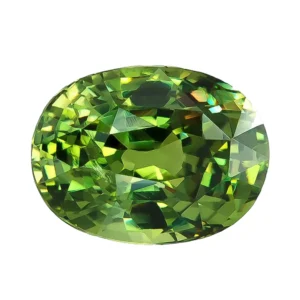
With a high refractive index (1.80 to 1.89), excellent luster, and deep green color, demantoid garnet outshines other famous gemstones like emerald, peridot, ruby, sapphire, and even high-quality diamonds. This green garnet remains a favorite, especially in modern jewelry art. It does not have synthetic (man-made) counterparts. Due to its beauty, this gemstone is considered a rival to emeralds. Jewel collectors worldwide often prefer it over diamonds.
Despite new demantoid garnet mines found in the 1990s, the stone remains very rare. High-quality, clean, deep green demantoid garnets are particularly valuable, with prices increasing per carat. Demantoid garnets with horse-tail, wavy, golden, and fibrous inclusions are especially popular among jewelry enthusiasts.
In terms of brilliance and dispersion, demantoid garnets exceed diamonds and other well-known green gemstones like emerald and peridot. Demantoids with lighter colors appear truly stunning under natural sunlight. While they might resemble emeralds in color, their optical and physical properties are quite different, with demantoids having greater dispersion, making them incomparable to other green stones.
Demantoid garnet is known for its vivid and bright green color, resulting from the presence of chromium and iron in its chemical structure. Its color can range from light green to dark green or brown but always retains high transparency and brilliance, distinguishing it from other garnet types. With a hardness of 6.5 to 7.5 on the Mohs scale, it is a durable gemstone suitable for everyday wear, though its relative brittleness requires careful handling.
One of the fascinating features of demantoid garnet is the phenomenon known as “fire,” caused by light dispersion within the stone. This effect gives the gemstone a unique sparkle and play of colors, enhancing its appeal.
Today, the primary sources of demantoid garnet are in Russia, Namibia, Madagascar, and Iran. Russian mines remain one of the most significant sources, but high-quality specimens also come from other countries.
Due to its beautiful color and special brilliance, demantoid garnet is highly valued in jewelry making. It is used as a gemstone in various pieces like rings, necklaces, earrings, and bracelets. When combined with precious metals such as gold and platinum, it adds a spectacular touch to jewelry.
Its rarity and beauty make demantoid garnet attractive to collectors and investors. This stone can be seen as a long-term investment, as its value increases over time.
To maintain the beauty and brilliance of demantoid garnet, regular cleaning is recommended. Warm water and mild soap can be used to clean the stone. After washing, it should be dried with a soft cloth. Due to its relative hardness and brittleness, the stone should be protected from heavy impacts and pressure. Storing jewelry containing demantoid garnet in separate, covered boxes can prevent scratches and damage. Generally, clean demantoid garnets larger than one or two carats are hard to find in nature, making them extremely rare and valuable. It is not a gemstone you will often see worn by others.
Proper understanding and care of this stone can help preserve its beauty and longevity. If you are looking for a unique and valuable gemstone, demantoid garnet is an excellent choice.

